
German javelin legend and former world-record-holder Uwe Hohn has recently weighed in on the rapid rise of Indian thrower Sachin Yadav, offering both praise and pointed criticism. Hohn believes that while Sachin has immense raw potential — including being capable of breaching 95 metres — his technique remains “very basic,” leaving a lot of untapped power. Hohn’s analysis underlines how, with the right technical fixes and coaching, Yadav could soon challenge the very best in javelin world history.
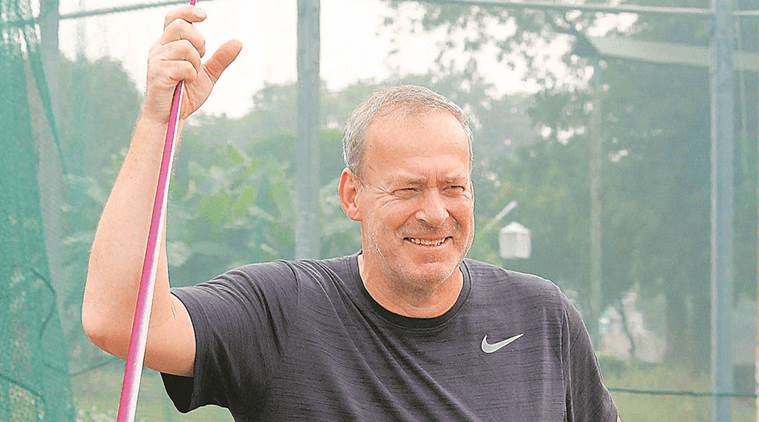
Background: Who Is Sachin Yadav
- Sachin Yadav, a 25-year-old from Khekeda, Uttar Pradesh, has become one of India’s brightest prospects in javelin.
- In 2025, he produced a personal best of 86.27 metres at the World Athletics Championships in Tokyo, finishing 4th and narrowly missing a podium spot by just 40 centimetres.
- His consistency has improved, with multiple throws over 85m in high-pressure competitions.
Who Is Coach Uwe Hohn
- Uwe Hohn is the only athlete in history to have thrown the javelin over 100 metres — his mark of 104.80m (1984) stands as an “eternal world record” because after his throw the javelin design was changed.
- He later turned to coaching; notably, he coached Neeraj Chopra in 2017-2018.
Hohn’s Key Observations and Critiques
- Technique Is “Very Basic”
Hohn says that Sachin’s technique is still rudimentary. That means that while his throws are powerful, more technical sophistication is missing. - Rhythm, Running, Body Position
According to Hohn, Yadav needs to refine his run-up, rhythm, and overall stability of his body. Not everything can come from the arm. The kinetic chain from ground through legs, hips, torso, shoulders, arm must be better integrated. - Arm Strength vs Full-Body Power Loss
Hohn praises his “good arm” and strength but believes there’s a significant loss of power because the throw overly relies on arm speed and strength rather than incorporating lower body drive and rotational torque. - Stability and Consistency Under Pressure
Despite strong throws, Hohn notes that technical issues like balance, stability, consistency, especially during competition, limit Yadav’s ability to podium. - What Needs to Change
Hohn believes that with the right coaching and adjustments, Sachin can make “drastic” technical improvements in:- body positioning,
- better run-ups (for rhythm and speed),
- reduced loss of power between phases,
- better use of non-arm parts of the body (legs, hips, core),
- possibly refining release mechanics and stability of posture.
Potential: 90m, 95m, or More
- Hohn states clearly that Sachin is already capable of throws in the 90-metre plus range, and with proper technical improvement (and a coach who understands what to fix), he could reach 95 metres and beyond. The Indian Express+1
- Comparisons are made with legends like Jan Zelezny and Hohn himself — athletes known for combining technique, rhythm, and mental strength. The Indian Express
What’s At Stake
- For Sachin Yadav: closing the technical gaps could mean moving from being a promising thrower to an elite world champ contender. Podium finishes, medal contention at major championships demand consistency at high performance.
- For Indian javelin: with Neeraj Chopra also in the mix, Sachin’s rise gives India more depth in this event; potential for friendly rivalry and increased training infrastructure demands.
- For coaching and athletic systems in India: Hohn’s critique underscores the importance of not just raw power or physicality, but technical coaching, biomechanics, strength-and-conditioning, and rhythm training.
How Sachin Can Improve – Possible Action Plan
- Refined Coaching
Bringing on a coach with international experience in javelin that can fine-tune technique from run-up to release; someone who understands the mechanics of kinetic chain. - Video Biomechanics Analysis
Using slow-motion video, biomechanical sensors, to identify where power is being lost (e.g. in transition, mismatch of hip-shoulder separation, stability in plant/leg phases, etc.) - Focused Drills
- Drills for run-up rhythm
- Hip and torso rotation drills
- Strength work for core, glutes, hamstrings (lower body)
- Stability / balance exercises for foot plant, posture
- Release angle and gripping consistency drills
- Competition Under Pressure
Regular competition to test technique under stress; simulation of championship conditions; monitoring consistency in throws across rounds. - Incremental Changes
Rather than overhaul everything at once, adjust one or two key aspects (such as run-up rhythm or hip drive) and monitor feedback before making further changes to avoid losing stability.
Challenges and Caveats
- Some technical corrections can initially reduce comfort or even produce temporary drop in performance. Managing athlete confidence and gradual adaptation is important.
- Physical limits, injury risk: increasing load on hips, core, etc., must be done with injury prevention in mind.
- Infrastructure & coaching support: Access to facilities, sports science support, nutrition, strength training, recovery.
Conclusion
Uwe Hohn’s evaluation of Sachin Yadav is cautiously optimistic. He sees unfulfilled potential: much to work on technically, but also major upside. If Sachin can harness better coaching and refine the aspects that are now “basic” — especially rhythm, body position, run-up, full-body engagement — the 95-metre throw is an achievable target. For India, this moment could mark the emergence of another world-class javelin thrower, adding depth to its athletics pedigree.
5 FAQs
- Q: Why does Hohn say Sachin Yadav’s technique is “basic”? What does that really mean?
A: It means that while Sachin has natural strength, arm speed, and a decent release, he has not yet fully developed the complex interplay between phases of a javelin throw (run-up, transition, delivery). Key aspects like rhythm, lower body contribution, body posture, hip-shoulder separation, stability during the plant and release are not yet refined. These are what differentiate world-class throwers from merely very good ones. - Q: Is 95 metres a realistic target for Sachin Yadav?
A: According to Hohn, yes — with the caveat that technical improvements must happen. Sachin has showed 86.27m, and the gap to 95m is large but not insurmountable if biomechanics, strength, and consistency are addressed. It depends on consistent training, coaching, and incremental improvements. - Q: What role does coaching play in achieving these big improvements?
A: Coaching is crucial. A coach can identify biomechanical inefficiencies, guide corrective drills, manage training loads, offer feedback and strategy, ensure the thrower improves without injury, and also prepare them mentally and competitively. Without coaching that can see and fix technical issues, natural talent alone will likely plateau. - Q: How does Sachin compare with other Indian throwers like Neeraj Chopra or with international throwers?
A: Compared with Neeraj Chopra, Sachin is seen as coming up fast and occasionally outperforming him in recent competitions (e.g., at World Championships). Chopra has more experience, learned under Hohn earlier, and has already achieved big distances. But by raw potential and physical stats, Sachin has comparable qualities and has already placed close to world podiums. Internationally, to reach the distances of Zelezny, etc., technical refinement is the differentiator. - Q: What are the typical technical fixes that can bring improvement? Which ones matter the most?
A: Some of the most impactful technical fixes include:- Improving run-up rhythm and speed to generate forward momentum
- Better use of lower body (legs, hips, glutes) and core during the throw for power transfer
- More stability in planting foot and body posture during the release phase
- Optimizing the release angle, technique of the wrist/arm, and ensuring clean, straight trajectory
- Strength and flexibility work especially in hips, core, shoulder, to avoid loss of power or injury
- Consistency via drills, frequent competitions, and feedback/sensor/video analysis
 Best Coach In India
Leave a comment